The Calendar area in the Youwell portal brings all of an organisation's appointments (group sessions, individual meetings and staff-only bookings) into a single view for clinicians and patients. This article explains the main ideas so the rest of the calendar articles make sense. If you are new to the Calendar, this is a good place to start.
From release 2026-R10 the Calendar is the calendar for every organisation that uses appointments. There is nothing to switch on. If your organisation does not use appointments at all, an administrator can hide the Calendar menu, the My calendar tile on the dashboard, the patient's Calendar tab and the patient app's Appointments page in one go, with Deactivate all appointment-functionality under Youwell settings in Settings.
If you would like help to get started, get in touch with Youwell support.
The three main ideas
- Appointment — a single planned activity at a point in time, such as a consultation, a group session or a video call. An appointment can reach one patient or many.
- Linked resources — how an appointment finds its audience. An appointment may be linked to therapists, user groups, patients, patient groups, lists, programmes or programme profiles.
- Template — a reusable plan of appointments that can be applied again and again, for example a standard course of sessions every patient in a programme should receive.
Who can do what
- Therapists, content creators, administrators and Mercantile users can create, edit and delete appointments.
- Content creators, administrators and Mercantile users can also manage templates and custom calendars.
- External therapists can see the appointments they are linked to, but cannot change them.
You can read more in Calendar roles, access and feature activation.
How the Calendar works
The Calendar was introduced in release 2026-R7 as an experimental feature, and replaced the previous group-session calendar for every organisation in release 2026-R10. Existing calendars, appointments and reminders were carried across automatically. You can read more in Migrating to the new Calendar.
Compared with the previous group-session calendar:
- Appointments are no longer tied to a single calendar or patient. They are targeted through Linked resources, so the same appointment can reach a user group, a programme profile and named patients at once.
- Every appointment has a Requirement field (Mandatory or Optional) that controls whether patients need to register and whether a maximum number of participants applies.
- Consent is configured per appointment, not per calendar.
- Appointments can repeat and be edited across a series.
- Notifications and reminder times are configured centrally at organisation level, and can be changed for a single appointment when needed (see Notification and reminder settings).
- Your own appointments are shown as My calendar, and appointments with your patients as My participants (see Navigating the calendar view).
- The previous Appointments tab on a patient profile is replaced by a Calendar tab, displaying all the patient's appointments.
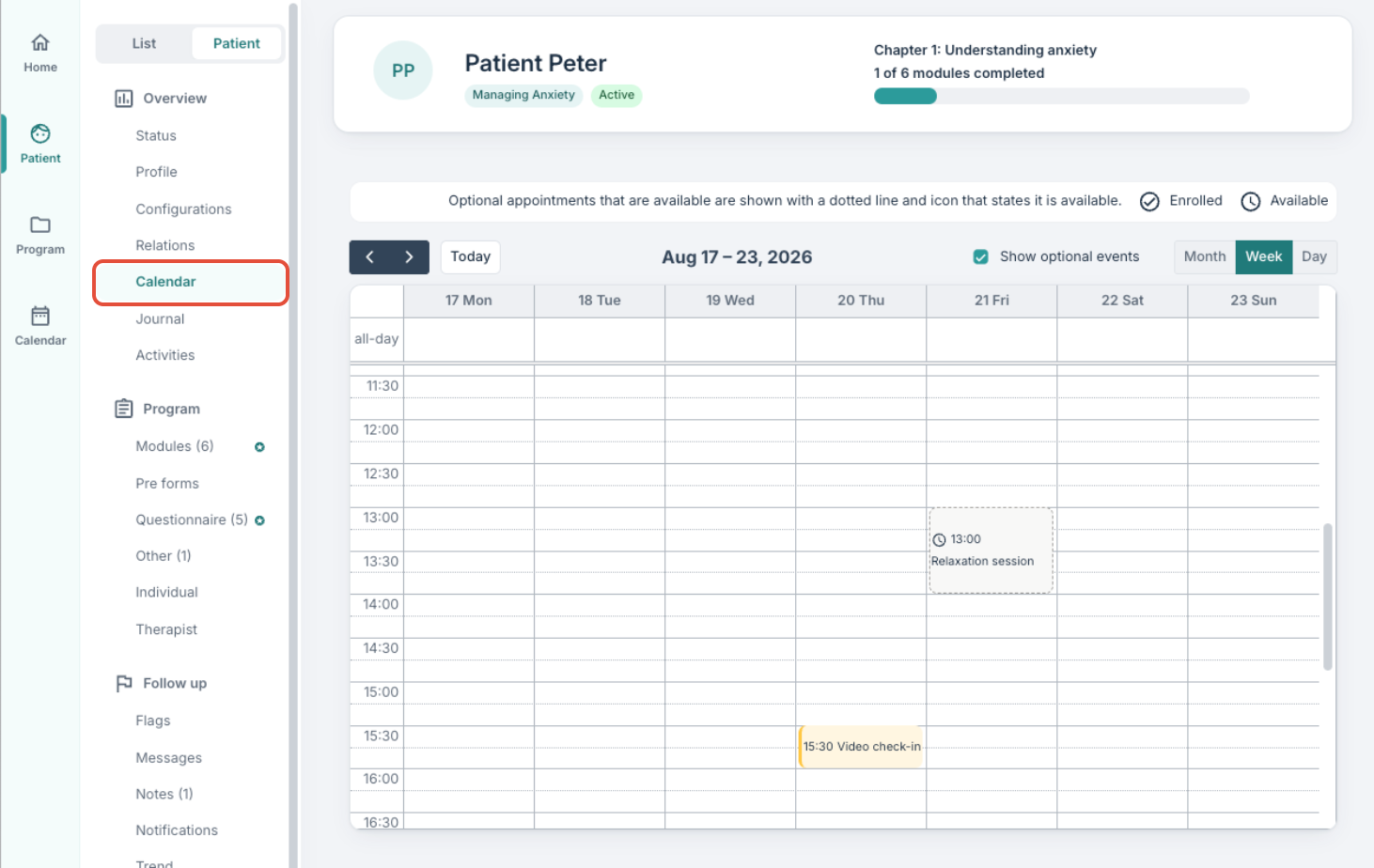
Main Calendar tab
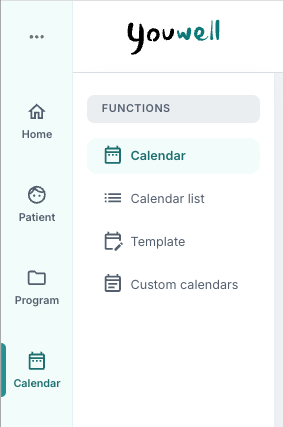
The Calendar tab appears in the main portal navigation. It contains up to three sub-areas:
- Calendar — the day/week/month view where appointments are created and managed.
- Template — reusable sets of appointments. Shown to users who can manage templates.
- Custom calendars — reusable resource groupings used to target appointments. Shown to users who can manage custom calendars.
Types of appointment
Different appointment types can be created:
- General — the default type, for any appointment that does not need one of the others. A location can be added, but is not required.
- Attendance — a physical meeting at a defined location. A location is required.
- Video — a digital meeting held through the configured video provider. Patients join directly from their appointment in the patient app.
- Phone call — a phone call at a specified time.
The type is set when the appointment is created and cannot be changed afterwards. If a mistake is made, it is best to delete the appointment and create a new one with the correct type.
Was this article helpful?
That’s Great!
Thank you for your feedback
Sorry! We couldn't be helpful
Thank you for your feedback
Feedback sent
We appreciate your effort and will try to fix the article